Programming
Analog Mayhem
Artist Talk, Workshops
Club SAW
Artist
Analog Mayhem
Live media performance presented by Ed Video in collaboration with SAW
Thursday, November 19, 2026 at 7PM
Club SAW (67 Nicholas Street, Ottawa)
Free admission
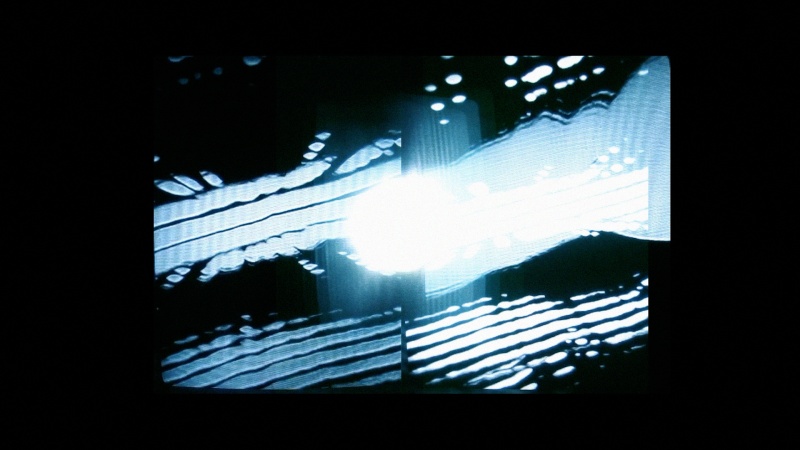
In Analog Mayhem, Tasman Richardson presents two live audiovisual works that push obsolete video technology past its limits, turning malfunction and feedback into image and sound drawn from the same source. Never Not Nothing (6 min) repurposes analog video feedback from obsolete tech, using RCA splitting, duplication and audio rerouting so the video literally sounds like it looks. The captured feedback is sliced into tones, textures and pulses, MIDI-triggered and composited live into complex expression pulled from nothing.
A Line Has Two Sides (18 min) draws power from an Atari 2600 to generate an endless stream of glitches, catalogued into playable video drum machines. The audiovisual triptych, MIDI-triggered and composited live, immerses the audience in hundreds of clips in a pulsating wall of visual music made entirely from its own source sound, a signature of the JAWA method Richardson developed in 1996.
“Scrambled and scratched into virtuoso techno-Pollocks”
— Catherine Elwes, Video Art: A Guided Tour
—
Artist talk and hands-on workshop with Tasman Richardson
Friday, November 20, 2026, 1PM–3PM
Club SAW (67 Nicholas Street, Ottawa)
Admission is free, but advance registration is required.
Register here.
Tasman Richardson defines video's essence and then offers two paths: video life or video death. Comparisons and demonstrations will include sampled cinema versus generated noise, and capturing memories versus harvesting glitches. He extends this to analog error versus digital stability, and ultimately to human possibility versus AI predictability: an end of time feeding on the past, or a collaboration with failure for an evolving future.
After the talk, the audience will be invited to move from spectators to participants in a hands-on exploration of analog video synthesis. Community members can sign up for guided sessions using Ed Video’s analog equipment, learning to generate and manipulate video signals by mixing live inputs, feedback and textures to create evolving visuals. With support from Richardson and Ed Video’s Technical Director, participants will experiment with tactile systems that respond in real time, discovering how images can be shaped through play and improvisation. The results will be projected on a large scale, transforming the space into a collective, ever-changing exhibition of community-generated work. The workshop demystifies specialized technologies while giving participants direct access to tools rarely available outside professional media arts facilities.
"[Tasman Richardson's] investigation of images tests the limits of our cultural and perceptual boundaries, which he breaks apart and reconfigures with disturbing precision."
— David Jager, NOW Magazine
—
About the artist
Toronto-based Tasman Richardson is a cultural composite, making cultural composites. His practice spans video art, immersive installation and live audiovisual performance. He established himself by pioneering his JAWA cut-up method in 1996 and co-founding the FAMEFAME arts collective and the Videodrome international audiovisual tournament. Richardson critically examines "contemporary necromancy," "voluntary surveillance" and video as "a soul without a body." His large-scale installations include Necropolis (MOCCA, 2012; Karsh-Masson, 2015) and Kali Yuga (Arsenal Contemporary, 2019 and 2020). More recent works investigate social silos and class war. His observations collected over two decades were published by Impulse(b) in his book Objects in Mirror, launched in Toronto, Berlin and Izmir in 2023. His work is held in the collection of the National Gallery of Canada.
—
SAW funders: Canada Council for the Arts, City of Ottawa, Ontario Arts Council, Ontario Trillium Foundation, Ottawa Community Foundation, Government of Canada and Government of Ontario